
8 Easy Guitar Chords for Beginners (Chart)
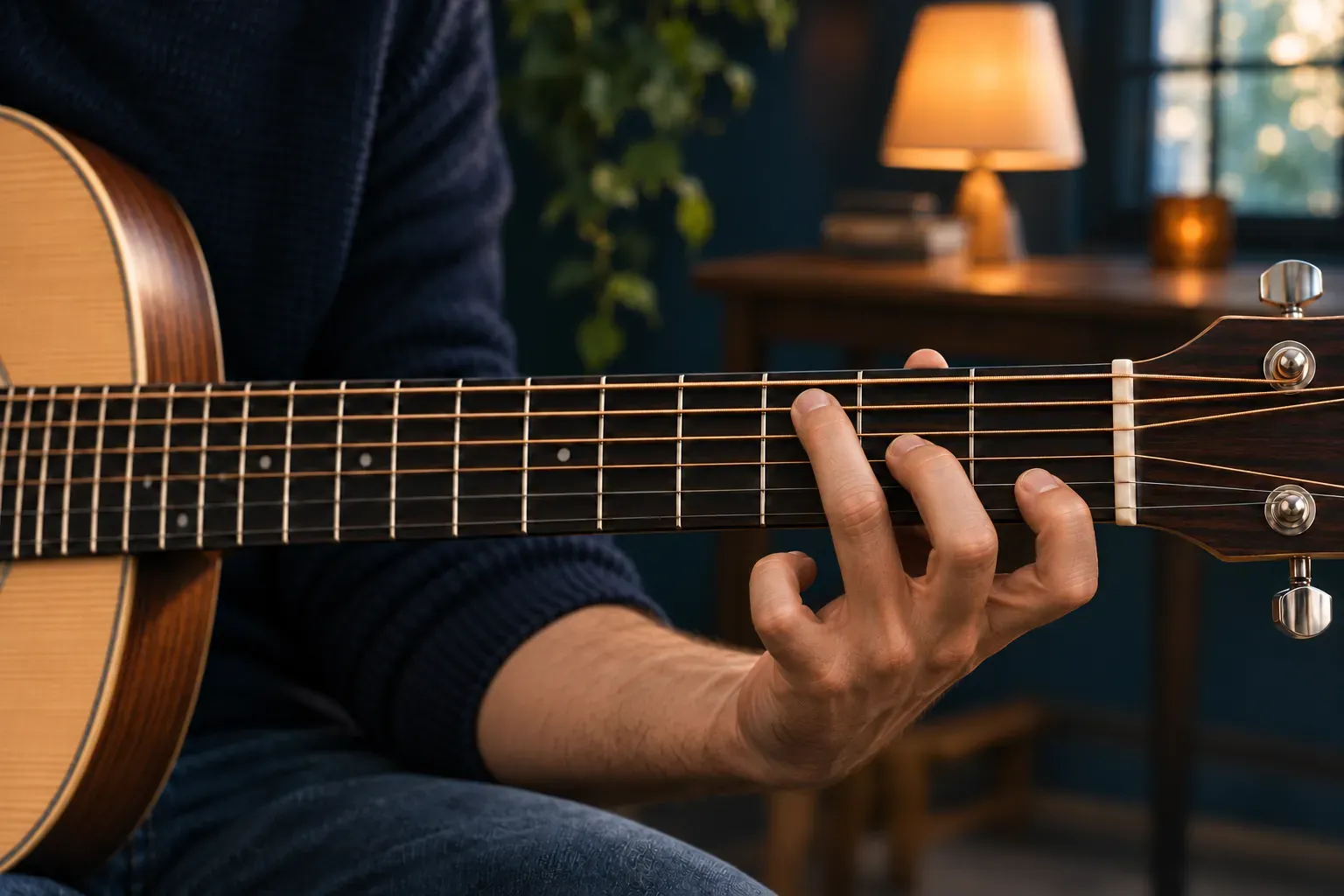
Every song you’ll want to play is built from chords, and the first ones are the friendliest. These 8 are open chords: they sit near the top of the neck, use open strings and don’t need a barre. Once your hand knows them, you can already play along with a lot of songs.
Here’s how to read the charts, the 8 shapes, the order to learn them in and how to make each one ring clean.
How to read a chord diagram
A chord diagram is a picture of the neck standing up, as if the guitar were facing you with the headstock at the top.
- The vertical lines are the strings. The thickest one, the 6th string, is on the left. The thinnest, the 1st string, is on the right.
- The horizontal lines are the frets. The thick line at the top is the nut, where the neck ends.
- A dot shows where a finger presses. The number inside tells you which finger: 1 is the index, 2 the middle, 3 the ring finger and 4 the pinky.
- An o above a string means you play it open, with no finger on it. An × means you don’t play that string.

Try it with C below. From left to right: skip the 6th string, ring finger on the 5th string at the 3rd fret, middle finger on the 4th string at the 2nd fret, 3rd string open, index on the 2nd string at the 1st fret, 1st string open.
The 8 open chords
The letter is the note the chord is built on. A letter on its own is a major chord, which sounds bright. A small m means minor, which sounds darker: Em is “E minor.”
Not every chord uses all six strings. Strum from the right string and the chord sounds full instead of muddy:
| Chord | Type | Strum from |
|---|---|---|
| C | major | 5th string |
| G | major | 6th string |
| D | major | 4th string |
| Em | minor | 6th string |
| Am | minor | 5th string |
| E | major | 6th string |
| A | major | 5th string |
| Dm | minor | 4th string |
Two shapes have a common alternative. Many people play G with fingers 2, 1 and 3, and A with fingers 1, 2 and 3 in a row. Both work. The fingerings in the charts above make the changes to C and to D shorter, which you’ll feel in the next section.
Which chords to learn first
A song never asks for one chord alone, so learn them in pairs. Each pair below shares something that makes the change easier.
- Em and Am. Em uses only fingers 2 and 3. To get to Am, move that pair over one string, toward the thinner strings, on the same fret. Then add finger 1 on the 2nd string, 1st fret. Start here.
- G and C. These two show up together in a lot of songs. Fingers 3 and 2 move over one string as a pair, and finger 1 joins in for C.
- D and A. Finger 1 stays on the 3rd string, 2nd fret, in both chords. Keep it pressed and move the others around it.
When those feel comfortable, add the last two. Both are close relatives of chords you already know.
E is Em plus one finger. Fingers 2 and 3 don’t move. Add finger 1 on the 3rd string, 1st fret, and the minor chord turns major. Play them one after the other and listen to the mood change.
Dm lives next to D. Finger 3 stays on the 2nd string, 3rd fret. The other two swap: finger 2 takes the 3rd string and finger 1 drops to the 1st string, 1st fret.
Learn your first chords with Musizz
A clean chord with no buzz
A buzz is a string rattling against a fret. A dead “thud” is a string that a finger is touching by accident. Both almost always come from the fretting hand, and these four checks fix most of them:
- Use the tip of the finger. Arch each finger like a little bridge, so it presses one string and stays clear of the next. Short nails make this much easier.
- Press close to the fret. Put the fingertip just behind the metal fret, not in the middle of the space. You need less force there, and the note rings clearer.
- Thumb behind the neck. Rest it on the back of the neck, around the height of finger 2. That gives your fingers room to arch. If your thumb hooks over the top, the fingers flatten and start touching other strings.
- Press just enough. Squeezing harder won’t fix a finger in the wrong spot, and it tires your hand fast.
Then test the chord one string at a time, from the first string you strum to the 1st string. When one sounds wrong, look at the finger nearest to it: is it too far from the fret, or leaning on that string? Fix that one finger and test again.
Your fingertips may get sore in the first weeks. That’s normal, and it eases as the skin gets tougher. A few minutes every day helps more than one long session a week.
4 chords, lots of songs
Here’s a reward for learning the first pairs. G, D, Em and C are the I, V, vi and IV chords of the key of G: the chords built on the 1st, 5th, 6th and 4th notes of the G major scale. That loop of four chords runs under a lot of pop and rock songs, so it sounds like music from the very first round.
Play each chord for 4 beats, one downstroke per beat, and go around again:
Count:  1 2 3 4 | 1 2 3 4 | 1 2 3 4 | 1 2 3 4
Strum:  ↓ ↓ ↓ ↓ | ↓ ↓ ↓ ↓ | ↓ ↓ ↓ ↓ | ↓ ↓ ↓ ↓
Chord:  G       | D       | Em      | C

↓ = downstroke
When every change lands on beat 1 without a pause, try 2 beats per chord. If one change keeps stopping you, these drills for switching chords faster work on exactly that.
How many chords do you need to know
There’s no magic number. If you count every chord type in every position, the guitar has hundreds of shapes. You don’t need them to start playing songs. A lot of songs use three or four chords, and many of them are on this page.
With these 8 you can play songs in several keys, as long as the song doesn’t ask for a barre chord. The first one most players run into is F. It has an easier version you can play today and a full barre you can build toward: how to play the F chord, step by step.
After that, let your songs choose. Write down the chords of the songs you want to play and learn the ones you’re missing. And when you want a different sound, power chords use one shape that moves anywhere on the neck.
Practice it with Musizz
Reading a chart is the easy part. The real skill is getting your hand into the shape fast, without looking at the chart again. In Musizz, Chords against the clock trains exactly that. A chord shows up with its shape, you play it before time runs out, and the app listens through the microphone of your phone or computer to check the notes it heard.
Pick the chords you’re learning, start with a pair or two, and add one more when they feel easy.
No cable and no interface. Just your guitar and the microphone.
Questions and answers
What are the easiest guitar chords to learn?
Em and E are usually the easiest, because they use only two or three fingers and you strum all six strings. Am, C, G, D and A come right after. All of them are open chords: they sit near the nut, use open strings and don't need a barre.
How many chords do I need to know on guitar?
There's no fixed number. Counting every type and every position, the guitar has hundreds of chord shapes, but you don't need them to start. A lot of songs use three or four chords, and many of those are open chords like the 8 in this article. The best list is the chords of the songs you want to play.
What are the basic guitar chords?
The open chords C, G, D, E and A, plus the minor chords Em, Am and Dm. A plain letter is a major chord, which sounds bright. A small m means minor, which sounds darker. With these 8 you can play songs in several keys, as long as they don't ask for a barre chord like F or Bm.
Why do my chords sound buzzy?
Usually a finger is too far from the fret, isn't pressing evenly, or is touching the string next to it. Press with the tip of the finger, just behind the fret, and keep the finger arched. Then play the chord one string at a time to find the string that buzzes and fix only that finger.
Which guitar chords should I learn first?
Learn them in pairs that are easy to change between: Em and Am, then G and C, then D and A. Add E and Dm after that. E is Em with one more finger, and Dm keeps one finger from D in the same place.