
How to Switch Chords Faster on Guitar: 7 Simple Drills
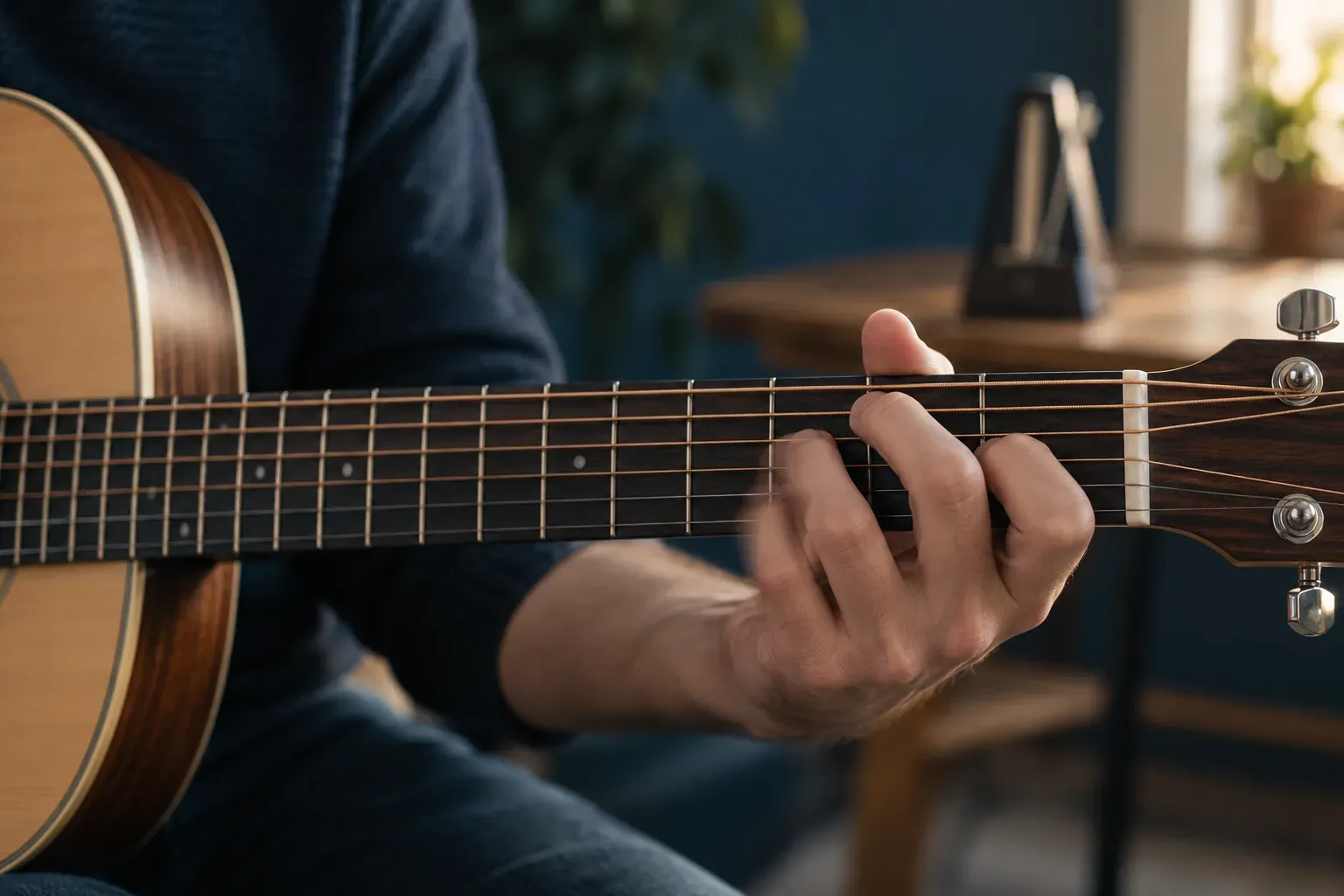
You know the shapes. G sounds fine. C sounds fine. Then the song asks you to go from one to the other, and the whole thing stops while your fingers look for their places.
That gap is normal, and you can train it like anything else on the guitar. Below are 7 drills that make chord changes faster and cleaner, from how your hand moves to how you keep time while it moves.
Why your chord changes feel slow
A slow change is rarely about speed. It’s usually about one of these:
- One finger at a time. You place the first finger, then look for the second, then the third. Three small trips instead of one.
- Fingers flying away. Between chords, your fingers lift high off the strings, so they have a long way back.
- Looking at every move. Your eyes check each finger before you strum, and the strum waits for your eyes.
- Stopping the strumming hand. The right hand freezes while the left hand works, and the rhythm breaks.
Each drill below fixes one of these. You don’t need all of them on day one. Pick the one that matches your problem and start there.
Move the whole shape, not one finger at a time
A chord is one shape, not three separate fingers. The goal is to lift the whole shape and land it at once.
Drill 1: Lift and land
- Make a C chord and strum it once.
- Lift all the fingers together, just a few millimeters off the strings. Keep the shape in the air.
- Put the shape back down, all fingers at the same time.
- Strum to check that every string rings.
Do this 10 times with C, then with G, then with any chord you find hard. When it feels easy, lift the shape a bit higher before landing it.
Drill 2: Change without strumming
- Make a G chord.
- Switch to C without strumming. Watch how your hand moves.
- Switch back to G.
Go back and forth slowly, 20 times, without making a sound. With no strum to wait for, you can pay attention to the hand: are all the fingers leaving together? Do they land together? Then close your eyes and do 10 more. Changing without looking is the goal.
Find the anchor finger (G to C, Em to Am, D to A)
Many chord pairs share a finger, or a pair of fingers that moves as a block. Use them as a guide, and the change gets shorter.
D to A. Play D with finger 1 on the 3rd string, 2nd fret. Now play A with finger 2 on the 4th string, finger 1 on the 3rd string and finger 3 on the 2nd string, all on the 2nd fret. Finger 1 never moves. It’s your anchor: keep it pressed and let the others move around it. Finger 3 stays on the 2nd string too and just slides back one fret, so only finger 2 really travels.
You may have learned A with fingers 1, 2 and 3 in a row. That works too, but this fingering gives you the anchor.
Am to C. Fingers 1 and 2 stay in place. Only finger 3 moves, from the 3rd string to the 5th string, 3rd fret. This is the easiest change in this whole article, which makes it a great warm-up.
G to C. No finger stays, but two of them move together. Play G with finger 3 on the 6th string, finger 2 on the 5th string and finger 4 on the 1st string. To get to C, fingers 3 and 2 move over one string, toward the thinner strings, as a pair. They stay on the same frets. Then finger 1 lands on the 2nd string, 1st fret.
The fingering matters here. If you learned G with fingers 2, 1 and 3, that works too. This one makes the change to C shorter.
Em to Am. Same idea. Play Em with fingers 2 and 3. Move that pair over one string, toward the thinner strings, and keep it on the same fret. Then add finger 1 on the 2nd string, 1st fret.
The one-minute changes drill
Drill 3: One-minute changes
This drill is simple and a little addictive.
- Pick two chords, for example G and C.
- Set a timer for one minute.
- Switch between them as many times as you can. Strum once on each chord.
- Count only the clean changes, where every string rings.
- Write the number down.
Do it every day with the same pair and compare. The number tells you whether the practice is working, and seeing it go up keeps you coming back. When a pair gets easy, write down your best and move on to the next one.
One rule keeps this honest: speed with a buzzy chord doesn’t count. If the count goes up but the chords sound bad, slow down.
Switch chords faster with Musizz
Change on time with a slow metronome
Fast changes in an empty room are one thing. In a song, the change has to land on the beat.
Drill 4: Change on beat 1
- Set a metronome to 60 BPM.
- Strum G on every click for 4 clicks.
- Change to C so that it lands exactly on the next click 1.
- Keep going: 4 clicks of C, 4 of G.
When that feels easy, strum 2 clicks per chord, then 1. After that, raise the tempo a little. If you miss the click, it’s too fast. Go back down and try again.

Keep strumming while you change
The strumming hand is the clock. If it stops, the song stops. Here is a small trick that keeps it going.
Drill 5: The open strum
- Strum down-up on G, counting “1 and 2 and 3 and 4 and”.
- On the last “and”, let the fretting hand go and strum the open strings.
- Land on C right on the next “1”.
That last strum on the open strings sounds fine in a song, and it gives your hand half a beat to travel. Your strumming hand never stops, so the rhythm doesn’t either.
Count:  1  &  2  &  3  &  4  &  | 1
Strum:  D  U  D  U  D  U  D  U  | D
Chord:  G  G  G  G  G  G  G  o  | C

D = down   U = up   o = open strings
If down-up is still new, start simpler: one downstroke per beat, and play beat 4 on the open strings. That gives your hand a whole beat to travel. When the change feels relaxed, go back to down-up and keep the open strum only on the last “and”.
The 5 chord pairs to practice first
Drill 6: Rotate the pairs
These five pairs show up in a lot of beginner songs, and each one teaches your hand a different move:
- D to A: finger 1 stays.
- Am to C: fingers 1 and 2 stay.
- Em to Am: the pair moves over one string.
- G to C: the pair moves over one string, and finger 1 joins in.
- G to D: no finger stays, so the whole shape moves at once, toward the thinner strings.
Do one-minute changes with two pairs a day and rotate. In a week, every pair gets practice.
Drill 7: Your song, your pairs
The best pairs to practice are the ones in the song you want to play. Write down the chords of that song, list every change in order, and do one-minute changes with the hardest one. When it stops being the hardest, practice the next.
If F shows up and stops you cold, that’s a common wall. It deserves its own article: How to play the F chord, step by step.
Practice it with Musizz
The hard part of one-minute changes is playing and counting at the same time. In Musizz, the One-minute changes drill does the counting for you. Pick 2 to 4 chords, play for a minute, and the app listens through your phone’s microphone and counts your changes.
When the count starts to climb, try Chords against the clock: a chord shows up with its shape, and you play it before time runs out. It’s the same skill, but now you don’t know which chord is coming.
No cable and no interface. Just your guitar and the microphone.
Switch chords faster with Musizz
Want more to practice? Start with 8 easy guitar chords for beginners, then build a daily plan with a guitar practice routine for beginners.
Questions and answers
How long does it take to switch chords on guitar?
It depends on how often you practice and on the pair of chords. Changes where a finger stays in place, like D to A, usually come first. Changes where the whole hand moves, like G to C, take longer. A few minutes a day on the same pairs beats one long session a week, and counting your changes shows you the progress.
How do I switch chords smoothly while strumming?
Keep your strumming hand moving no matter what. Start with one strum per bar, then two, then your full pattern. On the last upstroke before the change, strum the open strings while your fretting hand moves. That tiny open strum is normal and keeps the rhythm going.
How do I switch chords without the strings buzzing?
Buzz right after a change usually means a finger landed too far from the fret or didn't press evenly. Land each fingertip just behind the fret, with the finger arched so it doesn't touch the next string. The squeak while you move comes from sliding on the strings: lift the fingers slightly instead of dragging them.
Which chord changes should beginners practice first?
Start with Am to C, D to A and Em to Am, where a finger stays in place or two fingers move together. Then add G to C and G to D, where more of the hand moves. After that, practice the changes from the songs you want to play, because those are the ones you'll use.
How many chord changes per minute is good?
There's no official number. Use your songs as the target. A song at 100 BPM in 4/4 with one chord per bar has 25 changes a minute. When you can beat that count with clean chords, you're ready to try that song in time. Only count the chords where every string rings.