
How to Play the F Chord on Guitar, from Easy to Barre
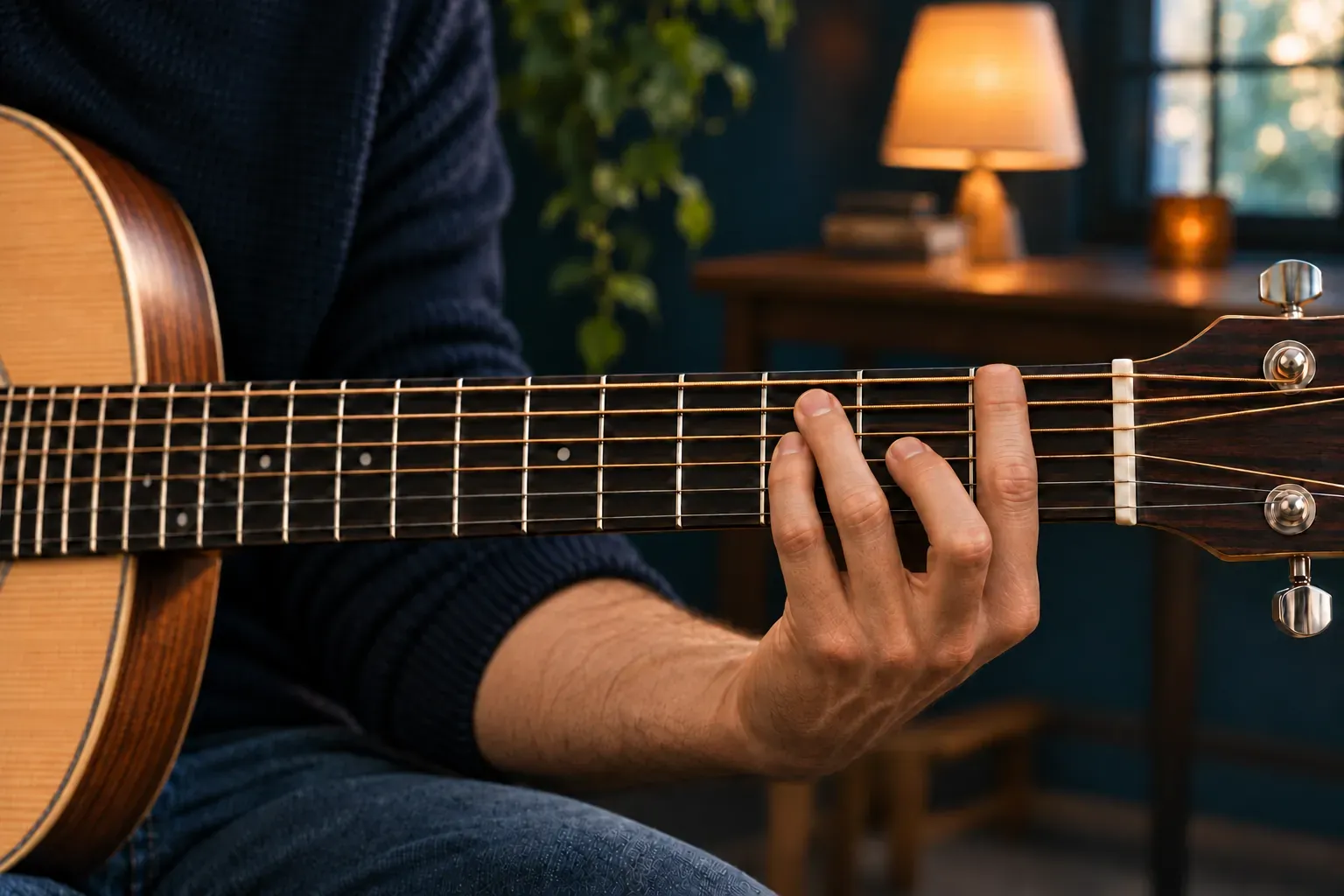
Your open chords are working. C, G, Am, all fine. Then a song asks for F, and suddenly half the strings go dead and your hand hurts.
A lot of guitarists hit this wall, and it has a real cause. The good news: you don’t have to climb it in one jump. Below is a path in four steps, from a version of F you can play today to the full barre, plus the thumb and arm tips that make the barre possible.
Why the F chord is hard
Open chords lean on open strings. F can’t do that. Its notes are F, A and C, and only one of the open strings, A, is part of the chord. So F needs a finger on almost every string.
You have four fingers and six strings. The answer is the barre: finger 1 lies flat across the strings and presses several of them at once. That’s hard for three reasons:
- The index finger isn’t flat. It has joints, and a string that lands in a crease between them goes dead.
- The 1st fret is the widest stretch. Frets get closer together as you go up the neck, so the stretch is biggest right where F lives.
- The other fingers still need their tips. While finger 1 lies flat, fingers 2, 3 and 4 have to stay arched on top of it.
What gets you through is position: where your fingers and thumb sit. That’s why the steps below work. Each one adds a small piece of the final shape.
Step 1: Fmaj7
Start here. Fmaj7 uses the same fingers 3, 2 and 1 as the full F, in the same places, with the 1st string open.
- Finger 3 on the 4th string, 3rd fret.
- Finger 2 on the 3rd string, 2nd fret.
- Finger 1 on the 2nd string, 1st fret.
- Strum from the 4th string down.
It isn’t exactly F. The open 1st string adds an E, which gives the chord a softer, dreamier color. In a lot of songs it works fine in place of F, and it puts three of your fingers right where the full F needs them.
Step 2: the easy F, no barre
Same three fingers as Fmaj7. The only change: don’t play the 1st string. Let the pad of finger 1 lightly touch it so it stays quiet, and strum only the 4th, 3rd and 2nd strings.
Those three strings play F, A and C, so this is a real F chord, small but complete. Strumming only three strings takes a bit of control. If it’s hard at first, play them one at a time, like an arpeggio, and then try a short strum.
Step 3: the mini barre
Now the 1st string joins in. Lay finger 1 flat across the 1st and 2nd strings, both at the 1st fret. It’s a barre on only two strings, and the easiest one you’ll ever play.
This is the F most songs need while you’re learning. Two tips:
- Roll finger 1 slightly onto its bony side, toward the headstock. The soft pad tends to mute the 1st string.
- Keep finger 1 close to the fret. The closer it sits, the less you have to press.
When these four strings ring, try a halfway stop: move finger 3 to the 5th string, 3rd fret, and put finger 4 in its old spot, on the 4th string, 3rd fret. Now you’re strumming five strings, and the low note makes the chord sound fuller.
Play a clean F chord with Musizz
Step 4: the full barre F
Lay finger 1 flat across all six strings at the 1st fret. Fingers 3, 4 and 2 sit on top, in the same spots as the halfway stop: finger 3 on the 5th string, 3rd fret, finger 4 on the 4th string, 3rd fret, and finger 2 on the 3rd string, 2nd fret.
Look at the shape of fingers 2, 3 and 4. It’s E, one fret higher. Each finger moves up a number, 1 becomes 2, 2 becomes 3, 3 becomes 4, so finger 1 is free to lie flat. If you know E, you already know most of this chord.
Build it in this order:
- Make the shape with fingers 2, 3 and 4 first, without the barre.
- Lay finger 1 flat behind them, close to the 1st fret.
- Play one string at a time, from the 6th to the 1st.
- When a string sounds dead, adjust only the finger on it, and play that string again.
Expect a few dead strings at first. Usually it’s the 2nd string, sitting in a crease of the index. Rolling finger 1 slightly toward its bony side, or moving it a millimeter up or down, often fixes it.
Thumb, wrist and pressure
Most barre pain comes from squeezing. These are the changes that help most:
- Thumb low and behind the neck. Rest it on the back of the neck, around the height of finger 2. Don’t wrap it over the top.
- Pull with the arm. Let the weight of your arm pull the neck slightly back toward your body. The pressure comes from there, and the thumb stops working like a clamp. If your thumb hurts, it’s a sign it’s doing too much.
- Wrist straight enough. Bring your elbow a little closer to your body, so the wrist doesn’t bend hard. A bent wrist steals strength from the fingers.
- Press just enough. Press until every string rings, then try a little less. You’ll find the barre needs less force than you think.
With small hands, start higher up the neck. Play the same full shape with finger 1 on the 5th fret: the frets are closer there, and it’s easier to get every string clean. Then move the shape down one fret at a time, toward the 1st. Tilting the neck up a bit, as classical players do, also gives your fingers more room.
Your hand may get tired fast at first. Take short breaks, shake it out and come back. A few minutes a day works better than a long session that leaves your hand sore.
From F to every barre chord
Here’s the payoff. The full F is a movable shape. The note under finger 1 on the 6th string names the chord. Slide the whole shape up and you get other major chords:
| Finger 1 on fret | Chord |
|---|---|
| 1 | F |
| 3 | G |
| 5 | A |
| 7 | B |
| 8 | C |
| 10 | D |
Lift finger 2 and the chord turns minor. With finger 1 on the 1st fret, that’s Fm, and it moves the same way.
You might know part of this shape already. Finger 1 on the 6th string and finger 3 on the 5th string, two frets up, is a power chord, with the root in the same place. If you’ve played power chords, your hand has done half the barre F before.
Practice it with Musizz
The hard part of the barre is hearing which string died, while your hand is busy. Musizz helps there. The course has a lesson called Barre chords: F and Bm. It shows where the thumb goes and how the arm does the pulling. Then you play the 2nd string under the barre, a string that often goes dead, and the app listens to check it rings. After that you play F and Bm, and the app tells you which notes of each chord it heard.
The mini barre F from step 3 comes earlier in the course, in the lesson on the chords of C major, so you can play songs with F while the full barre is still on its way.
When the shape feels steady, put F in Chords against the clock with the chords you already know. The chord shows up, you play it before time runs out, and you find out if your F holds up when you don’t know it’s coming.
No cable and no interface. Just your guitar and the microphone of your phone or computer.
Play a clean F chord with Musizz
Still working on your first chords? Start with 8 easy guitar chords for beginners. And when F shows up in the middle of a song, these drills for switching chords faster help you get there on time.
Questions and answers
Why is the F chord so hard on guitar?
Because F has almost no open strings to lean on. It needs a finger on nearly every string, and with four fingers for six strings, the index has to lie flat and press several strings at once. That's the barre. On top of that, the 1st fret is the widest stretch on the neck.
How do you play F without a barre?
Play only the 4th, 3rd and 2nd strings: finger 3 on the 4th string, 3rd fret, finger 2 on the 3rd string, 2nd fret, and finger 1 on the 2nd string, 1st fret. That's a full F chord on three strings. Fmaj7 is another option: same shape with the 1st string open, a softer sound that fits many songs.
How long does it take to learn barre chords?
It varies a lot from person to person, and nobody can give you an honest deadline. What makes the difference is a few minutes on the barre almost every day, checking string by string. While the full barre isn't there yet, you can play your songs with the easy F or the mini barre.
Why does my barre chord buzz?
Usually the index finger isn't pressing one of the strings evenly, often because a string falls in the crease of a joint. Move the index closer to the fret, roll it slightly onto its bony side and play one string at a time to find the dead one. The other fingers also need to stay on their tips so they don't touch the strings next to them.
Can you play the F chord with small hands?
Yes. The barre depends more on position than on hand size. Keep the thumb low behind the neck, pull with the arm instead of squeezing with the hand, and practice the shape higher up the neck first, where the frets are closer together. Then slide it back toward the 1st fret.